Passion and Persistence
Novel Notes
Historical Context & Inspirations
From the Author
Why Persistence — Not Pride — Is the Heart of This Story
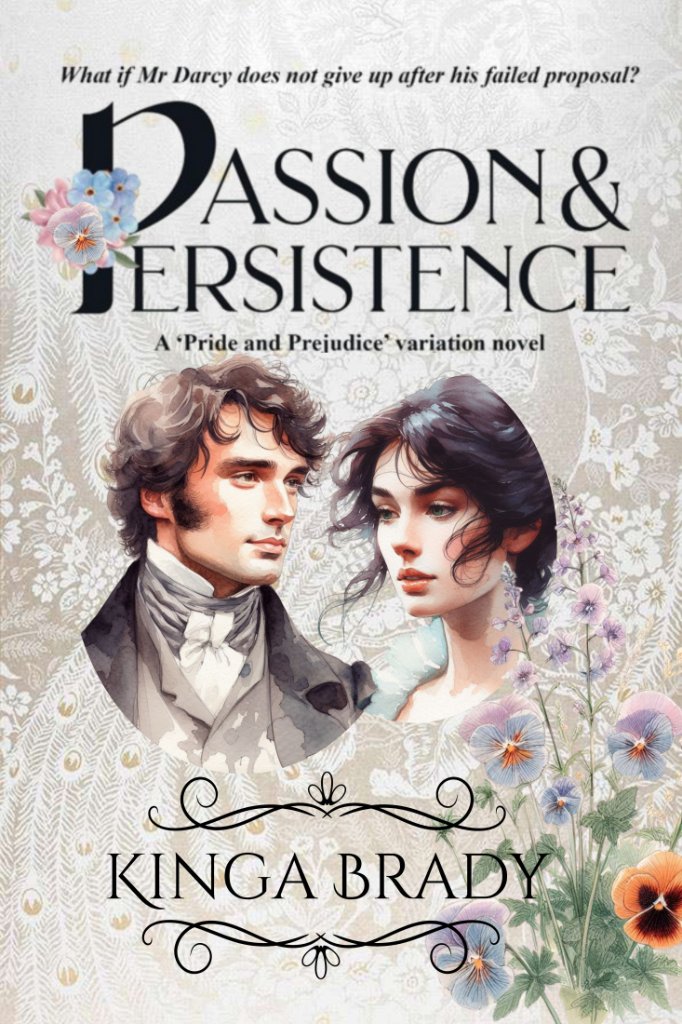
When I sat down to write Passion and Persistence, I was not interested in retelling Pride and Prejudice. I was interested in what happens after the rejection — after the letter, after the pride, after the hurt. I wanted to ask a single, stubborn question: what if Mr Darcy refused to let go?
In Austen’s novel, Darcy retreats after Hunsford. He goes home, he broods, and he waits for fate to bring Elizabeth back into his orbit. That is a perfectly fine course of action for a man of his standing — but it is not, I think, what a man in love would do. A man truly in love does not retreat. He persists.
So I gave my Darcy a different instinct. He does not flee to Pemberley and hope. He takes Netherfield from Bingley and moves in — because she is just beyond those trees, and he will not surrender. It is presumptuous, audacious, and by the standards of Regency society, almost scandalous. But his persistence is born not of arrogance; it is born of love. And that distinction is everything.
I wanted to explore what happens when a man chooses to stay — not in grand declarations, but in quiet constancy. Darcy does not demand; he waits. He does not press; he persists. And slowly, through proximity rather than persuasion, he dismantles the prejudices Elizabeth built against him. Some hearts, I believe, are won not by a single plea, but by the refusal to give up.
Writing this novel was also a way for me to weave in pieces of my own heritage — the Hungarian vizsla, the hussar, the Grand Tour through Vienna. These are small touches, personal ones, but they remind me that every story we write carries something of who we are. I hope you find them as delightful to discover as I found them to include.
I will not give you up.
— Kinga Brady
Historical Information
The world Darcy and Elizabeth inhabit is grounded in real places and real customs. These locations and traditions — from Rotten Row to the Regency picnic — shaped the story and lent it texture.
Prologue
Darcy House
In Passion and Persistence, Darcy maintains a London residence — Darcy House — from which he launches his campaign to win Elizabeth. This imagined townhouse sits among the grand streets of Mayfair, within easy riding distance of Hyde Park and the fashionable drawing rooms where society gathers. It is here, in the solitude of his study, that Darcy licks his wounds after Hunsford — and here, days later, that he emerges with a plan.
Chapter 1
Rotten Row
During the 18th and 19th centuries, Rotten Row was a fashionable place for upper-class Londoners to be seen horse riding. It was established by William III at the end of the 17th century. Having moved court to Kensington Palace, William wanted a safer way to travel to St. James’s Palace. He created the broad avenue through Hyde Park, lit with 300 oil lamps in 1690 — the first artificially lit highway in Britain. The lighting was a precaution against highwaymen, who lurked in Hyde Park at the time. The track was called Route du Roi, French for “King’s Road,” which was eventually corrupted into “Rotten Row.” In Chapter 1, Darcy and Richard give their horses a good gallop on Rotten Row before heading west toward the countryside.
Chapter 1
Hyde Park at the Edge of the City
Today, Hyde Park is embedded in London, covering all the area on the map and more. But in the Regency era, Hyde Park was at the very edge of the city — on three sides there was still nothing around it. This pocket map by Mogg shows the city as Darcy would have navigated it in 1806, from Hyde Park in the west to the Tower in the east. The 1822 illustration by Cruickshank shows Hyde Park Corner as it appeared in Darcy’s time.
Chapter 1
The Grand Tour
During the 17th and 18th centuries, rich young Englishmen finished their education by going on The Grand Tour — an extended cultural and collecting trip through continental Europe. You can think of it as a “finishing school” for the sons of the gentry. Darcy travelled through France and Italy on his Grand Tour, where he learnt how coffee should be drunk in Italy — and from that time on, he preferred to drink tea at home. It is also plausible that he picked up his Hungarian vizsla in Vienna along the way.
Courtship Customs
The Language of Flowers
During the Regency era, courtships were the equivalent of modern-day dating. A young man would visit a young lady at her home, escort her on walks and promenades — always properly chaperoned, of course — and send her flowers after dancing together at a ball. The pansy flower represents the thoughts of lovers, shared before a word is spoken. Named for the French word for “thought” (pensée), the pansy was said to be a charmed flower, possessing telepathic magic: attending to the plucked bloom, you could hear your lover’s thoughts. Forget-me-nots mean true love — while traditionally this flower represents remembrance, they also carry several other meanings including true love, devotion, and royalty.
Chapter 8
The Georgian Almond Cheesecake
Jane Bennet’s speciality. Georgian almond cheesecake was a far cry from the modern baked variety — it was a delicate confection of ground almonds, cream, eggs, and rosewater, often served at elegant dinners. Its inclusion in the story is a small nod to Jane’s quiet accomplishments, the kind of domestic art that a gentlewoman of her standing would have perfected.
Chapter 11
Let Them Eat Stale Bread
Britain was running out of bread in 1800. The Napoleonic blockade was beginning to have an effect, and British domestic production had not yet started to increase. Bread filled the bellies of the poor: children had dry bread for breakfast; workers had bread and cheese for their lunch; the workers’ wives had bread and lard; drinkers had a salted herring and a slice of bread in the pub; everybody had bread as the main accompaniment for scraps of bacon. Only on Sunday afternoon did bread not rule the house.
Chapter 11
The Regency Barouche
A four-wheeled carriage with a falling top, a seat on the outside for the driver, and two double seats on the inside arranged so that the sitters on the front seat face those on the back seat. Its “light construction” and little protection from inclement weather made this a summer carriage — the vehicle of choice for the wealthy who wished to see and be seen in the great parks.
Chapter 14
Darcy's Dog — the Hungarian Vizsla
The author indulges a personal touch here: she is Hungarian by origin, and it is plausible that Darcy could have picked up this noble breed in Vienna on his Grand Tour. The Hungarian vizsla is an ancient sporting dog — a graceful, golden-rust pointer with a keen nose and an affectionate temperament. Known as the “Velcro dog” for its loyalty, it would have been a fitting companion for a man as steadfast as Darcy.
Chapter 14
Hussar — the Dog’s Name
The Hungarian hussar is a national emblem, representing the rebirth of the ancient Hungarian horseman in the era of firearms. A hussar is a member of the light cavalry who, in the past half millennium, demonstrated prowess in the wars with the Turkish to defend his hearth and home, or to assert his national rights in the wars of independence against the Habsburgs. A hussar wears a busby with a bag or plume, a richly braided dolman jacket and tight trousers, a colourful braided belt, short boots with spur, and a richly braided pelisse slung over his left shoulder. He also wears a sabre and a sabretache on a shoulder belt, and has a carbine on the saddlebow and a pair of pistols at hand.
Chapter 15
Wrotham Park
A magnificent English country house set in 2,500 acres of parkland, Wrotham Park sits 17 miles from Hyde Park Corner. Built in 1754, it has served as a filming location for numerous period dramas. In the novel, it provides a setting for the kind of country-house gathering where society’s expectations and Darcy’s persistence collide.
Chapter 16
Darcy's Carriage
“This is a very comfortable carriage, Mr Darcy,” Elizabeth commented as she fidgeted in her seat and looked around. She was sitting with her sisters in a row and did not feel cramped at all. Her legs had enough space, a miracle since the gentlemen were tall. The inside was luxuriously fitted with heavy silk of cream, and the seats were cosily padded. “Is it new? It has this new smell.” Darcy chuckled. “New smell? Yes, as a matter of fact, it is quite new. I bought it before I went to Rosings.”
Chapter 24
The Regency Picnic
The Regency picnic was no casual affair. Tables and chairs were hauled into scenic spots, liveried servants laid out cold meats, game pies, fruits, and jellies, and the party dressed as though for a garden party. The picnic at Box Hill in Jane Austen’s Emma is the most famous literary example, but the tradition was a staple of genteel summer life — an opportunity for conversation, flirtation, and the kind of carefully staged leisure that Darcy and Elizabeth’s world made into an art form.
Continue the Journey
Read the First Chapters
Begin Darcy’s story — from the meadow where he surveys his new property to the moment his persistence brings him face to face with Elizabeth once more.
Read Now
