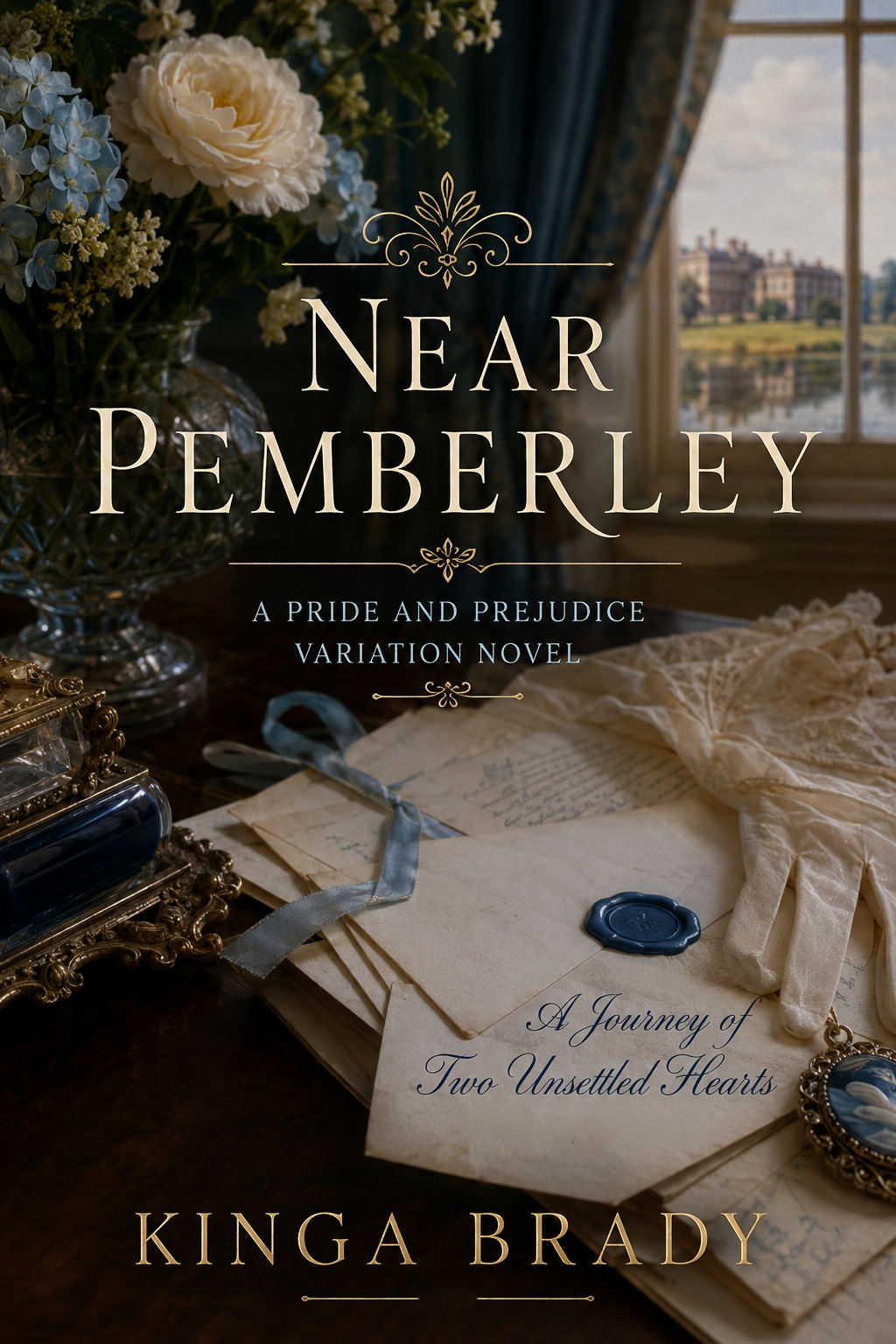
A Pride and Prejudice Variation — Published on 1st September
Near Pemberley
A Journey of Unsettled Hearts
Exclusive Early Preview
Published on 1st September
Be among the first to step into the world of Near Pemberley. Read the opening chapters below — an exclusive first look before the full novel arrives.
Published on Amazon on 1st September.
The Story
Months after refusing Fitzwilliam Darcy's proposal, Elizabeth Bennet finds herself travelling through Derbyshire with her aunt and uncle. Time and reflection have softened some of her certainties, yet many questions remain unanswered.
As she draws nearer to Pemberley, memories she had hoped to leave behind become impossible to ignore. New impressions begin to challenge old assumptions, and every unexpected discovery forces her to reconsider the man she once believed she understood.
Meanwhile, Darcy struggles to move forward from a rejection he has never truly forgotten.
Set against the beauty of the Derbyshire countryside, Near Pemberley is a story of misunderstandings, second impressions, family loyalties, and the quiet moments that can alter the course of a life. As familiar events unfold in unfamiliar ways, Elizabeth and Darcy must each decide whether the past should remain where it belongs—or whether some paths deserve to be travelled a second time.

Theme song for Near Pemberley
I Found My Heart in You
Listen to the other theme songs

Exclusive Preview
Chapter One
A Journey to Lambton
Lambton, Derbyshire — Beginning of August
Elizabeth shifted in her seat for what must have been the third or fourth time within as many minutes, though the carriage moved steadily enough to give her no real cause for discomfort.
Mrs. Gardiner, who sat opposite, glanced at her with a faint smile. “You are not easy, my dear,” she said. “Was the journey too long?”
“No, not at all,” Elizabeth replied quickly. “I am very well, I assure you.”
And she was, in every way that ought to signify. They had a hearty breakfast; the day was fine for travel; the road mostly agreeable, and the Derbyshire countryside offered views which, under other circumstances, she would have admired without reserve.
Yet she found it impossible to sit still.
They were now within a few miles of Lambton.
And beyond Lambton lay Pemberley.
She was vexed with herself for even thinking about the fact, but there it was. She looked out of the window, but she saw very little of what passed before her.
It was unreasonable to be so affected. She had known, when the plan of their tour was first proposed, that this part of the country might bring them uncomfortably near to places she would rather avoid. She had even believed herself prepared for it.
But to be actually here, with every turn of the road bringing them nearer to the neighbourhood of Mr. Darcy, tried her composure severely.
She checked the thought almost at once with impatience.
It was no longer of consequence. Whatever feelings she had once entertained, whether of resentment or something less easily named, they had no proper place now. She had refused him. The matter was settled.
And yet the idea persisted, despite all her reasoning.
That he should be so near.
That she might, by the merest accident, encounter him…
She could not easily prevent her imagination from pursuing the idea further.
She saw it clearly. His look of surprise, perhaps, at seeing her there. Or worse, no surprise at all, only that composed civility which admitted of nothing further. He would bow. She would curtsy. A few words would be exchanged, proper, unremarkable, and entirely void of meaning.
Or he might be cold. That, too, she had reason to expect.
Or altered.
That possibility, she did not know how to consider.
Then she thought of herself as being ungenerous. She had reason to believe that he would behave a gentleman… even if she had confronted him about his behaving otherwise.
There were moments now when she wished she could remember every word spoken at Hunsford with greater certainty.
At the time, she had believed herself entirely justified. Yet memory, viewed at a distance, was seldom so obliging.
She could still recall the force of her anger. What she could no longer determine was whether every expression of it had been equally deserved. After all, whatever his faults, he had spoken of genuine feeling.
Mr. Gardiner, who had been studying the landscape with increasing satisfaction, leant forward suddenly. “There, Lizzy – look there. Is that not a fine view?”
Elizabeth turned obediently towards the window.
“It is indeed,” she replied.
“What did I tell you, Husband?” said her aunt cheerfully. “Derbyshire improves with every mile.”
Mr. Gardiner smiled and agreed, while Elizabeth continued to look in the direction indicated, though she could not afterwards have described what she had seen.
If they met…, would he speak with ease? Would it give him pain to see her again?
And how should she behave?
With indifference, as she had once wished? With politeness only? She could not suppose herself equal to perfect composure, and the idea of betraying anything more was almost less unwelcome.
Another thought, less reasonable but still troubling, forced itself upon her. That he might not be surprised at all. That he might think she had come there on purpose.
The colour rose faintly in her cheeks at the thought. That he should suppose her capable of seeking him out, of placing herself in his way after all that had passed between them, was an idea she could hardly endure.
And with that came, unbidden, the memory of his words.
How ardently he had loved her.
She could not recall them without agitation. There had been pride in them, certainly, and offence enough to justify all that she had felt at the time. Yet there had been something else as well, something she had not then been inclined to consider.
That such a declaration should have been made at all, and made to her, was not a circumstance easily forgotten.
She wondered now whether he thought of it still. Whether he regretted it or wished it unsaid. Whether he had since convinced himself that his attachment had been no more than a passing folly.
The thought should have given her peace, but she found it gave her none at all.
She turned her head slightly, as if to escape the persistence of her own reflections. But thoughts, once admitted, are not so easily dismissed; and Elizabeth, who had often prided herself upon commanding her own spirits, found them at present very little disposed to obey her.
It was absurd to speculate on a meeting which might never occur.
Elizabeth made a deliberate effort to put on her gloves, as if the small action might steady her.
“I believe we are near Lambton now,” said Mr. Gardiner, leaning slightly forward to look out. “Another few minutes should bring us to the inn.”
Mrs. Gardiner followed his glance and began quietly to prepare for their arrival.
Elizabeth made some answer though she hardly knew what.
The carriage soon slowed, then turned, and at last came to a stop before a neat and respectable inn, whose appearance promised comfort without pretension. A servant came forward at once, and the bustle of arrival left her no leisure for further reflection.
It was only once they were shown into their sitting room, and the first civilities were concluded, that Mr. Gardiner returned to a subject he had already mentioned more than once upon the road.
“We are now so near Pemberley,” he said, “that I cannot persuade myself to quit the neighbourhood without seeing it. It is said to be one of the finest places in the county. Even my book says so.”
Elizabeth felt again that inward resistance, though she kept her manner composed. “I have heard as much,” she said. Then, with an attempt at carelessness, she added, “After seeing so many, I can take little interest in carpets and curtains. If I recall, the library, on the other hand, is said to be remarkable.”
“Indeed? Then I am sure,” he replied, “you could visit one more big house. Your aunt assures me it is worth a visit.”
“If it were only a fine house, elegantly appointed,” Mrs. Gardiner said, “I should not trouble myself to see it either; but the grounds are indeed exceedingly beautiful. I still remember them. They are really among the finest in the county.”
“If the family is not at home, we may view it without inconvenience,” her husband surmised.
Mrs. Gardiner looked from one to the other. Seeing her niece hesitating, she added, “We may enquire first. There can be no harm in that.”
Elizabeth inclined her head, though she would willingly have avoided such certainty.
Mr. Gardiner stepped out to speak with one of the servants of the house, who appeared accustomed to such questions. The door closed behind him, and for a moment Elizabeth stood very still, as if listening for something she could not completely define.
She told herself she did not care what answer might be returned.
Indeed, it would be simplest if the family were absent. There would then be no awkwardness, no possibility of meeting him.
She moved towards the window, though she did not look out.
It was a mere matter of convenience. Nothing more.
When her uncle re-entered, she faced him at once.
“Well?” said Mrs. Gardiner.
“Mr. Darcy,” he replied, “is expected shortly with guests. Miss Georgiana is there already. It seems they may already have returned or will do so within the day.”
Elizabeth’s composure faltered, if only for a moment. “Already?” she said.
“So I am informed. In any case, they are not absent in the way we had supposed. The man says that visitors are usually welcome even when the Darcys are home. People are rarely turned back without at least being shown the garden. The housekeeper will know what areas to avoid.”
“Oh, how lovely. This was not the case in his parents’ time.” Mrs. Gardiner glanced briefly towards Elizabeth. “That does not quite accord with the character you once described. Did you not say he was proud and unpleasant?”
There was a brief pause.
“You could send a note that you are in the neighbourhood,” her aunt offered.
Elizabeth looked up quickly. “Certainly not.”
The answer escaped her with more haste than she intended.
Mrs. Gardiner smiled slightly. “My dear, I meant no more than a civil acknowledgement.”
“Mr. Darcy can have no interest in knowing that I am in Derbyshire.”
“I dare say he would not think so.”
“I should think so enough for both of us,” Elizabeth replied.
Mr. and Mrs. Gardiner shared a worried glance. Mr. Gardiner then said, “Then just come with us as visitors. We do not have to meet him or his guests.”
Elizabeth lowered her gaze and, after a moment, said with quiet firmness, “I would rather not go.”
Later, after a short walk, her aunt tried to reason with Elizabeth. “Lizzy, you even know the man.”
“Precisely so,” Elizabeth replied. Her voice was steady, though she did not immediately raise her eyes. “I have met him more than once. That is reason enough.”
Mrs. Gardiner regarded her with mild surprise.
“Do you not recall, Maddie, that she even danced with him?” Mr. Gardiner said lightly.
Her aunt looked back at her. “Reason against it, you mean? I should have thought the opposite.”
Elizabeth forced a small smile, though it did not quite reach her eyes. “I cannot agree. It would place us in a very awkward situation. To arrive there as mere sightseers, and then be recognised… I should not like it.”
“You need not suppose it will happen,” said her aunt gently. “We might see the grounds only and quit the place before any meeting could occur.”
Elizabeth shook her head. There was a moment’s pause before she spoke, as though ashamed to have hesitated at all. “That is a chance I would rather avoid.”
Mr. Gardiner, who had listened with some curiosity, now spoke. “My dear Lizzy, we would not willingly place you in discomfort. Yet I confess I am disappointed. It is said to be a place of uncommon beauty, and we are so near. You have borne all the inconveniences of our journey with such patience that I had hoped you would not refuse yourself what may prove its greatest reward.”
Elizabeth hesitated. She felt the justice of his wish and would not appear selfish. Yet the thought of going troubled her. To refuse appeared ungracious; to consent, for reasons she could not own even to herself, worse still.
“I would not prevent you,” she said at last. “If you and my aunt wish to go, you must by all means do so. Only do not expect me to accompany you.”
Mrs. Gardiner studied her for a moment, her expression softening. “You are fairly decided, then?”
Elizabeth paused. For an instant, the answer did not come. Her resolution, which had seemed so fixed while opposition was distant, faltered beneath kindness.
“I am.”
There was a pause, not of displeasure, but of quiet consideration.
“Very well,” said Mrs. Gardiner at last. “We shall not press you. Your uncle and I may go alone.”
Elizabeth inclined her head in gratitude, though she felt little ease from the concession.
The matter appeared settled, yet when her aunt turned away, she remained where she was, her hand resting lightly upon the back of a chair.
She told herself she was relieved.
She had avoided the risk, the embarrassment, the possible mortification of a meeting she could not command herself to face. She had acted prudently. She had preserved herself from every appearance of seeking him.
And still, as the silence returned, another feeling intruded, less welcome and more difficult to name.
She would not see him.
The certainty of it brought her less relief than she had expected. It settled upon her as a disappointment, though she would have been hard-pressed to say what hope had been disappointed.
She moved at last, slowly, towards the window.
It was a foolish thought, and she tried to dismiss it.
Yet she could not help wondering whether, had she gone, she might have found him altered. Or whether she herself had already changed without fully knowing it.
Or whether some moments, once declined, might not be so easily recovered.
Chapter Two
What Was Seen at Pemberley
Lambton — The Following Day
The next day, Elizabeth did not at first intend to be long from the inn.
She had gone out with no fixed purpose, only a wish for quiet, and the morning was so mild, the air so soft upon the hills, that she had continued almost without noticing how far she had come. The lanes were pleasant, the hedgerows thick with summer growth, and the motion itself afforded her some relief, though her thoughts remained unsettled.
More than once, however, they returned to the same point.
Her aunt and uncle would now be at Pemberley.
She did not dwell upon it. She had chosen not to go. The reasons for that choice had been sufficient and must remain so.
Not of him, she told herself, but of the place. Whether it was indeed as fine as described. Whether the grounds justified such praise. Whether the house looked as she had imagined it – or whether, like its master, it might prove less easily judged at a distance.
She checked the thought, almost with impatience, and turned her attention resolutely to the path before her.
By the time she returned to Lambton, the sun stood higher than she had expected. The inn appeared quiet. No carriage stood before it, and within, everything seemed as they had left it.
“They are not yet come back, ma’am,” said the maid, when Elizabeth inquired. “They have been gone a good while. There is much to see, I am told.”
Elizabeth thanked her and went upstairs.
For a moment, she stood in the middle of the room, uncertain whether to sit or walk again. She moved to the table with her sewing box and took out Jane’s letter from some weeks ago.
The contents were affectionate and calm, filled with those small domestic details which, from Jane, always carried a particular charm. Nothing was amiss. Nothing to alarm. Her mother was in spirits, her father as usual, her sisters much the same. The cousins made up most of her days, as keeping them from creating havoc was almost an occupation in itself. Elizabeth could almost hear their noise while she read.
She smiled once or twice, and when she had finished, she remained a moment with the letter in her hand, her thoughts softened.
There was always comfort in Jane.
She folded the letter carefully and laid it aside.
For some time, she sat quietly. The stillness of the room, so lately welcome, now seemed to press upon her.
They had been gone a long while. Longer than she had expected.
She rose and crossed to the window, though she did not look out at once. When she did, she found nothing to engage her attention. A cart passed, a few figures moved along the street, but none belonged to her party.
From below came the sound of movement within the inn – a servant hurrying along the passage, the sharp ringing of a bell, and somewhere beneath her window, a child laughing loudly before being hushed with little success. The ordinary bustle of the house continued undisturbed, while she alone seemed incapable of letting the hour pass quietly.
The grounds must be extensive, she told herself. Or they had been detained. By what, she did not consider.
She moved away again, took up her gloves, set them down, then sat once more. It was a small restlessness, but she could not entirely command it.
To her mortification, the image came to mind: she, Elizabeth Darcy, receiving her aunt and uncle. Then they would not be staying at the inn… but she remembered too clearly what he had said at Hunsford. What if her relations, being in trade, would not be welcome at… Pemberley?
She stopped herself almost angrily. Had she not already learnt the injustice of forming conclusions from wounded pride? And yet the memory of his proposal was not so easily separated from the man himself. He had loved her; he had insulted her; he had written with candour; he had proved himself, in many particulars, better than she had believed.
The welcome sound of wheels upon the gravel reached her.
With relief, she stood at once.
Voices followed, her aunt’s clear tone, her uncle’s answering, both speaking at once, as if each eager to be heard before the other had done.
Elizabeth resumed her seat before they entered, though she could not have said why.
Mrs. Gardiner came in first, her bonnet slightly displaced, her cheeks touched with colour. “My dear Lizzy, we have had such a day…”
“Such a place!” said Mr. Gardiner behind her, removing his gloves. “You cannot conceive it.”
“But I protest I am quite fatigued,” she added, laughing. “I have not walked so much in…”
“Nor I,” said he, “and yet I would not have missed it.”
Elizabeth rose to greet them. “I am very glad you have been pleased.”
“Pleased!” repeated Mrs. Gardiner. “My dear, it exceeds everything. The grounds… oh, the grounds alone… The gardener was so knowledgeable and kind. He gave me some seeds. He said they would do well under the window.”
“The finest I have ever seen,” said Mr. Gardiner, nodding. “Beyond expectation. You would have loved it.”
The words struck her more than they ought.
“And the stream, Lizzy! I do not exaggerate when I say I have rarely seen a finer stretch of water for fishing. I ought to have enquired whether they would permit it, for I could very willingly have spent an entire day there.”
“Your uncle,” said Mrs. Gardiner, laughing, “was ready to establish himself at Pemberley entirely.”
“And with good reason,” he replied. “If a man cannot be content at Pemberley, I do not know where he may hope to be so.”
“But the house,” she continued, “though we must do it justice later, for I cannot speak of it properly now.”
“And dinner first,” said her husband. “I insist upon dinner.”
Elizabeth smiled. “That may be arranged, I believe.”
They spoke a little longer, though their account was broken and confused, each beginning where the other had not finished, until at last they agreed that a fuller description must wait.
When they met again below, the room was livelier, and the presence of others imposed some restraint upon their eagerness. Yet it did not wholly subdue it.
They had only just been seated when Mrs. Gardiner, who had been attempting to compose her account from the moment she entered, at last began in earnest.
“My dear Lizzy, I do not know how to give you any idea of the place, for I find myself unequal to the task. It is not merely that it is large, or well-situated, though it is both, but that there is such a harmony in everything one sees. Nothing appears forced, nothing arranged for show. The grounds seem to belong to the house, and the house to the grounds, in a way I have not often observed.”
Mr. Gardiner, who had been helping himself, nodded in agreement.
“Your aunt does not exaggerate. I have seen a great many fine places in my time, but I do not remember one which pleased me more. The woods alone would be worth the journey. They are extensive, but not crowded, and laid out with a degree of judgement which suggests a mind not merely proud of possession, but capable of valuing it properly.” He paused, then added, “From what you have said about him, I expected that arrogance to show, but although everything is of the finest quality, I saw a place that felt like a home. There is grandeur, certainly, but without ostentation.”
Elizabeth inclined her head; she said nothing.
“Yes, that is it, Lizzy,” Mrs. Gardiner agreed. “I wonder whether the taste we admired belongs chiefly to him or was formed under his mother’s direction.”
Elizabeth listened with polite attention, though she found herself forming a clearer picture than she had intended.
“I am very glad you were so well rewarded,” she said. “I had feared it might prove no more than another large house.”
“That would have been a great disappointment,” said Mrs. Gardiner, smiling, “but I assure you, it is quite otherwise. Even the interior, which I had thought might be too grand for my taste, is remarkably well arranged. Your uncle is entirely right. There is elegance, certainly, but also comfort. One feels that it is inhabited, not merely exhibited.”
Elizabeth found herself wishing she had seen it.
The admission was unwelcome.
She reached for her glass rather than answer.
A house so spoken of could not easily be dismissed as the mere parade of wealth, and despite herself, she began to connect it with its owner.
“And we were shown everything with the greatest propriety,” her aunt continued. “The housekeeper is a most respectable woman, and exceedingly well-disposed. Indeed, I do not think I have ever met with one more ready to speak in favour of her master.”
Mr. Gardiner set down his glass.
“That is very true. I was struck by the manner in which she spoke of him. There was none of that measured praise that one sometimes suspects is prepared for visitors. She spoke as one who had long observed his conduct and was satisfied with it.”
Elizabeth could not help but look up.
“She praised him so highly?”
“In the highest terms,” said Mrs. Gardiner. “She described him as the most considerate of landlords, and the best of masters. She spoke with an earnestness that carried conviction. I am persuaded she believes every word she said.”
Elizabeth was silent for a moment.
“Then she must think very highly of him indeed,” she said thoughtfully.
“Yes,” said her aunt. “I thought so too. There was nothing in her manner that suggested exaggeration. On the contrary, she seemed almost unwilling to say so much and yet could not help it.”
Elizabeth lowered her gaze.
This was not easily reconciled with what she had long believed. Or rather, it fitted too readily with what she had lately learnt, and that was almost more painful.
“There was another circumstance,” Mrs. Gardiner went on, after a short pause, “which surprised us still more. We saw a likeness of another gentleman among the portraits.”
Elizabeth felt a slight uneasiness.
“Mr. Wickham,” said her aunt. “We spoke of him quite naturally, as one connected with the place. But the housekeeper’s manner altered immediately.”
Mr. Gardiner added, “Not in a way that could be called rude, but sufficiently to be observed. She was far less ready to speak.”
Elizabeth’s attention sharpened. “In what way?”
“She acknowledged that he had been known there from his childhood,” said Mrs. Gardiner, “and that he had been a great favourite of the late Mr. Darcy. She said he had been brought up at Pemberley and had everything that could be given him.”
Mr. Gardiner continued quietly, “But she added, with some reluctance, that he had turned out very wild, and was not at all what he ought to have been.”
Elizabeth’s fingers tightened slightly upon her napkin.
This was no new information to her. Yet to hear it confirmed by another voice, and that voice belonging to Pemberley, gave the truth a weight which her own recollections had not quite possessed.
“And she said no more than that?” she asked.
“No more of consequence,” said Mrs. Gardiner. “Yet she called him wild and said it with a gravity which made the word seem to contain much more than she wished to express.”
Elizabeth felt the colour rise faintly in her cheeks. “It is a strong accusation.”
“It is,” her aunt replied. “And I would not repeat it lightly. I know you liked him. Yet I must own, I saw no reason to doubt her. She had nothing to gain by misrepresenting him, and she spoke rather as one who regretted the necessity of saying so much.”
Elizabeth did not instantly answer.
“I believe I may have been mistaken in my former opinion of him,” she said at last. “Indeed, I no longer think of him as I once did.”
“Indeed?”
“He has left the neighbourhood. He will not be missed by those who have had occasion to know him better.”
Mr. and Mrs. Gardiner looked at each other.
There was a short pause, during which Elizabeth appeared more thoughtful than before. Her aunt, with the delicacy of affection, asked no more, but her silence showed that she understood there was more to be known.
It was Mrs. Gardiner who resumed the subject, though with a lighter tone. “But we must not conclude our account in so serious a manner. There is something else we have not yet told you, and which perhaps will interest you more.”
Elizabeth looked up; she tried to appear indifferent. “What is that?”
“We have seen the gentleman’s portrait,” said her aunt, with a small smile.
Elizabeth could not help but return it. “Mr. Darcy’s?”
They both nodded enthusiastically.
“And what did you think of it?”
“That it was very like what I expected,” said Mrs. Gardiner, “and very favourable. He is, beyond question, a handsome man, though I suspect the painter has made him appear more severe than he truly is.”
Mr. Gardiner added, “Though I must say, the portrait does not quite do him justice.”
Elizabeth’s attention was now fully engaged. “Does it not?”
“No,” said Mrs. Gardiner. “For we had the opportunity of judging for ourselves.”
Chapter Three
What Was Not Said
The Inn at Lambton — That Evening
Elizabeth started slightly.
“You met him?”
“We did, indeed,” said her uncle. “Quite unexpectedly. He came into the house while we were there and addressed his housekeeper and then us with the greatest civility.”
“More than civility,” said Mrs. Gardiner. “He would not hear of Mrs. Reynolds abandoning us in the middle of the tour. There was a degree of ease in his manner which surprised us exceedingly. Nothing of that reserve which we had been prepared to expect.”
Elizabeth could not conceal her astonishment.
“That is very unlike what I have known of him – or thought I knew.”
“So we thought,” her aunt replied. “You had not led us to expect such manners.” She shook her head. “I must do him justice. I have rarely met with a gentleman more desirous of making himself agreeable. He showed us every attention and appeared perfectly at ease in doing so.”
Elizabeth was silent.
“His conduct towards Mr. Wickham is now placed in a very different light. Perhaps, Lizzy, he had other motives than jealousy in denying him the living. After what we learnt about him from the housekeeper, I would not be surprised. We were too hasty in our judgement.”
Elizabeth felt all the force of her previous righteousness. She regretted the quickness of her tongue.
But what struck her most was that Mr. Darcy could behave with such civility towards strangers. She could not easily reconcile this account with her former impressions, and yet she could not doubt the testimony of those who had witnessed it. “And he remained with you long?” she asked, after a moment.
“For some time,” said Mr. Gardiner. “Long enough to show us that we had formed a very imperfect judgement of him… There was something else I liked in him,” said Mr. Gardiner thoughtfully. “He did not seem a man trying to impress us. Indeed, I believe he forgot entirely that there was anything to be gained by doing so.”
Elizabeth lowered her eyes. She had no answer to make.
Nor was silence any refuge; for in that silence every word she had heard seemed to arrange itself against her former certainty. She had refused to see Pemberley, and yet Pemberley had found its way to her all the same – not in stone, timber, or prospect, but in the testimony of those whose judgement she trusted.
Mrs. Gardiner took up her glass, set it down again, and then said, with an air of recollection, “There was one circumstance more, Lizzy, though I am not certain whether I ought to mention it.”
Elizabeth looked up quickly. “What circumstance?”
Her aunt hesitated only a moment.
“Your uncle mentioned that we had a niece with us in Lambton.”
Elizabeth’s colour changed.
“Yes,” said Mr. Gardiner. “It seemed natural enough. He had asked whether we were long in the neighbourhood, and whether we had come far. I was on the point of saying that our niece was Miss Elizabeth Bennet…”
Elizabeth bent her attention suddenly to the table before her. She felt her heart give one painful, foolish bound.
“And did you say so?”
“No,” said Mrs. Gardiner gently. “At that instant, Mrs. Reynolds reminded us that we had still the library to see, and Mr. Darcy took his leave of us with great politeness.”
Elizabeth’s eyes lifted before she could prevent them. “And he seemed in haste to go?”
“Not in haste,” said Mrs. Gardiner thoughtfully. “Only recalled, perhaps, to what was proper. He appeared attentive to the last.”
For one uncomfortable moment, Elizabeth wondered whether such ease was only possible because she no longer occupied any place in his thoughts.
Elizabeth lowered her gaze again. This was worse. Had he been cold, indifferent, or even impatient, she might have known what to think. However, his consideration left too much room for imagination.
Elizabeth looked down at her plate, though she could not have said what was upon it. The room seemed, for a moment, to have grown both louder and more distant. Voices from a neighbouring table reached her without meaning; the scrape of a chair, the opening of a door, the clink of glass – all were strangely distinct, and yet none seemed to belong to the present moment.
“So, he does not know,” she said at last.
“No,” replied her uncle. “My dear wife, afterwards, reminded me that it would have been very impolitic to mention your name, when you had so plainly wished to avoid being named.”
“I thought it better if I did not speak,” Mrs. Gardiner added. “You had not wished to go, my dear, and I could not tell whether you would thank us for carrying your name where you had refused to carry yourself. I hope we did not disappoint you.”
Elizabeth attempted to smile. “No, not at all.”
Mrs. Gardiner regarded her for a moment with a gentler expression than before. “I am not certain of that,” she said. “From what we saw of him, I should not suppose he would have been much discomposed.”
Elizabeth fidgeted with her glass.
“Indeed,” her aunt added, “he appeared particularly desirous of being agreeable. I cannot think he would have been otherwise than pleased to see you again.”
Elizabeth lowered her gaze, and for a moment, made no reply. The idea, once suggested, struck her with more force than she cared to admit.
“Yes,” she said at last, with a faint effort at composure, “it is just as well.”
It was what she had chosen.
Yet the relief which should have followed did not come.
Instead, there arose a sense of something forfeited – something she had not known she valued until it was no longer within her reach.
He did not know, she repeated inwardly.
He had been near. He had spoken to her aunt and uncle. He had shown them civility – more than civility. He had been easy in his manner, attentive, even desirous of pleasing.
And she, who had once thought such effort impossible to him, was now left to wonder for whom such effort had been made.
The thought was mortifying. Or in reality, it was worse than that. It was simply painful.
Mrs. Gardiner, observing her silence, said kindly, “I hope we did right in not naming you afterwards. Since you had expressly wished to avoid the visit, I thought you might not thank us for introducing your name without permission.”
“You did quite right,” Elizabeth answered at once. “Perfectly right.”
Her voice was steady. “I would not have had you do otherwise.”
Mr. Gardiner regarded her with mild curiosity but said nothing.
Then, after a pause:
“Though I confess I still regret not asking more about the fishing.”
“Edward!” said Mrs. Gardiner.
“My dear, I am perfectly serious.”
Mrs. Gardiner turned back to her niece and rested her eyes on her a moment longer.
Elizabeth forced herself to take up her fork, though she had no appetite.
“Indeed,” she added, with a faint attempt at liveliness, “I should have been very much obliged to Mrs. Reynolds had I known how well she served me.”
The jest was poor. Her aunt smiled, but not as though deceived.
“Then we are forgiven,” said Mr. Gardiner, willing to accept the lighter tone.
“There is nothing to forgive.”
And yet there was something to regret.
Not in them. Not in their discretion. But in the moment itself.
A chance interrupted by a housekeeper’s innocent zeal for duty.
It was absurd that so small an accident should matter. Had her uncle spoken, what then? Mr. Darcy might have thought no more of it. He might even have suspected her of contrivance, which was precisely what she had dreaded.
Yet another possibility continued to trouble her.
He might have wished to know. He might – perhaps – have come.
She checked herself at once, almost with indignation.
That way lay vanity, folly, and mortification enough for any woman of sense. Had she not refused him? Had she not given him every reason to avoid her? What right had she to imagine that her presence in Lambton could be anything to him now?
Still, the thought remained with her.
He had been altered – at least in the eyes of those who had seen him. And she, who had chosen absence as the safest course, was now condemned to learn of that alteration only by report.
She could not really escape the suspicion that prudence had looked very much like cowardice.
Mrs. Gardiner began again upon the beauty of the grounds, and Mr. Gardiner added some description of the stream, the woods, and the approach to the house; but Elizabeth heard them imperfectly. She answered when addressed, smiled when it was proper, and looked composed enough to satisfy any observer less affectionate than her aunt.
But her thoughts had gone where she had refused to go.
To Pemberley.
To a gallery she had not entered.
To a gentleman who had not been told she was near.
And to one word – her own name – which had almost been spoken.
The full novel is published on 1st September.
More chapters will be revealed soon. Return for further previews.
Tagline
"Some hearts are unsettled not by distance, but by the unbearable weight of being near."
Characters
- Elizabeth BennetThe heroine — drawn near Pemberley by chance
- Fitzwilliam DarcyMaster of Pemberley — unsettled by a visitor
- Mr. GardinerElizabeth's uncle — a genial guide through Derbyshire
- Mrs. GardinerElizabeth's aunt — who once knew Pemberley's grounds
- Jane BennetElizabeth's elder sister — a comfort from afar
- Mrs. ReynoldsHousekeeper of Pemberley — loyal champion of her master
- Miss Georgiana DarcyDarcy's younger sister — quietly in residence at Pemberley
- Lydia BennetElizabeth's youngest sister — lively, heedless, and never far from trouble
- Mr. WickhamA once-charming acquaintance — whose past unsettles former judgements
Tropes

Visit Author Website

