


❧
Austen's World
Why Could a Regency Lady and Gentleman Not Be Alone Together?
Why was it improper for an unmarried lady and gentleman to be alone together in the Regency era? The answer lies in one word: reputation.
22 July 2026Read more →
Regency Romance & Austen-Inspired Fiction
Where every heroine deserves a happy ending — and every story, a bit of wit and wonder.
Every story begins with a question
The Collection
The Shelf Behind the Stories
What I Read
The novels that shaped my understanding of the Regency — and taught me how to write the stories I wanted to tell.
Evelina
Frances Burney · 1778
“The novel that changed everything.”
A young woman's entry into London society — and the mortifications, misunderstandings, and triumphs that follow. Burney's sharp eye for social comedy directly shaped Austen's narrative voice. Jane read it, loved it, and learned from it.
Burney taught Austen how to make the marriage plot matter — that a heroine's social standing could be as gripping as any adventure.
Cecilia
Frances Burney · 1782
“Where "pride and prejudice" first appeared together in English literature.”
The phrase that became a title appears in the closing pages of this novel. Beyond that gift, Cecilia is a masterwork of social pressure — an heiress who must forfeit her name to marry, and the impossible choices that follow.
The phrase itself. But also Burney's understanding that money, name, and love are never separate questions in the world she and Austen shared.
The Mysteries of Udolpho
Ann Radcliffe · 1794
“The gothic novel Catherine Morland could not put down.”
Radcliffe's most famous work — brooding castles, whispered secrets, and a heroine who must learn to distinguish imagination from reality. Austen both loved and satirized Radcliffe in Northanger Abbey.
Radcliffe defined the gothic sensibility that permeated Regency reading culture. Understanding her is understanding what Austen was gently mocking.
Belinda
Maria Edgeworth · 1801
“Austen's only declared literary influence.”
Austen sent Edgeworth a copy of Pride and Prejudice, calling herself a "grateful pupil." Belinda tackles courtship, race, and female independence with a boldness that even Austen admired from a distance.
Edgeworth proved that a woman could write seriously about society without apology — and that the novel was the form for it.
The Sylph
Georgiana, Duchess of Devonshire · 1779
“Written by a duchess who lived the life Austen's heroines could only imagine.”
A thinly fictionalized account of the author's own disastrous marriage and gambling addiction. Read today, it's a reminder that the gilded world of the ton had very sharp edges.
The real Regency was darker than any drawing-room scene suggests. Georgiana's novel is a window into what Austen's characters never say aloud.
Emma
Jane Austen · 1815
“Because no reading list is complete without Austen's most perfect novel.”
A heroine who is almost entirely wrong about everything — and the slow, exquisite process by which she learns to see clearly. Austen's most technically accomplished work and, to my mind, her greatest.
Every time I read Emma, I find something new. It is the novel I return to when I need to remember why I write.
These are the books I reach for when I need to hear the Regency speak again.
What if I stepped beyond adaptation and created a story wholly my own?
— Kinga Brady

A Social Directory
Social Standing
Master of Pemberley, £10,000 a year
Key Scandal
Publicly declared a lady merely "tolerable" at a country assembly — and has been paying for it ever since.
Proud, guarded, and impossibly honourable. In each variation, his path to love takes a different turn — yet his devotion, once earned, remains absolute. He also makes a guest appearance in Whispers of the Heart, briefly crossing into Catherine's world.
Appears In

"The greatest
adventure of all."
The Author
Jane Austen's world has long been my literary home. Through my variations, I explored alternative paths, emotional nuances, and the "what-ifs" hidden between her lines.
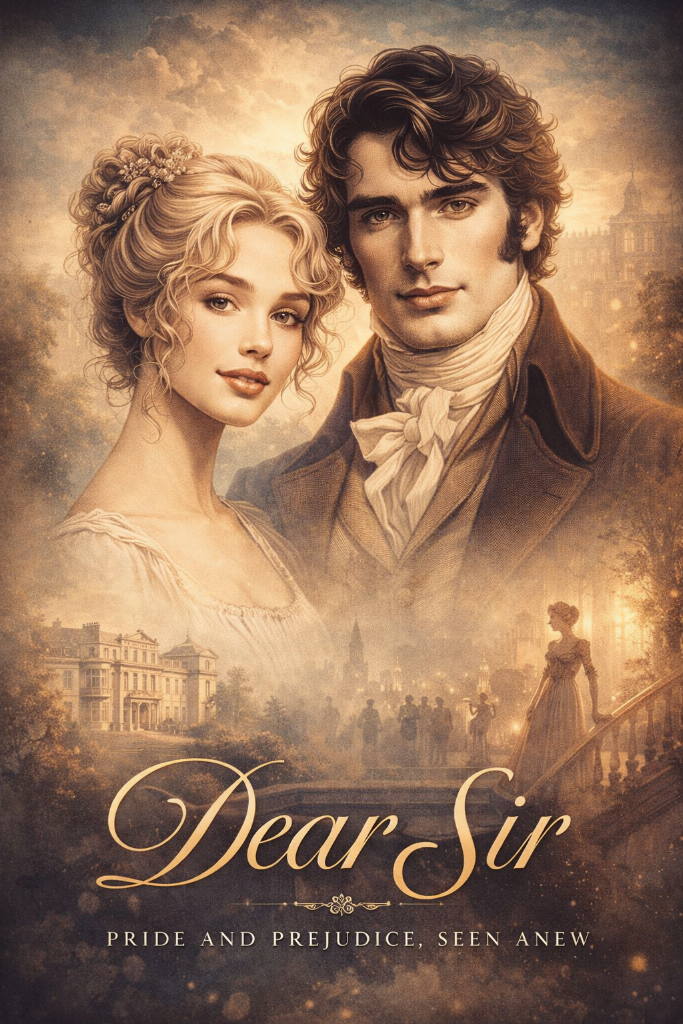
My journey began with Dear Sir, — a daring variation that earned both lavish praise and, remarkably, death threats from die-hard Pride and Prejudice fans who objected to my boldest creative choice.
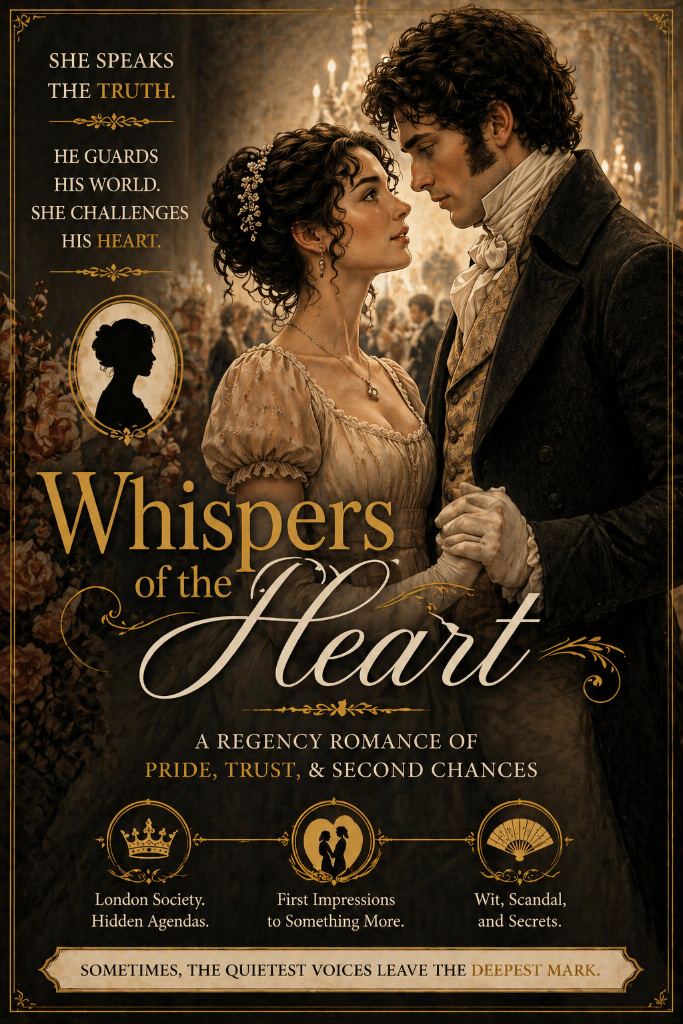
Over time, a quiet question surfaced: What if I stepped beyond adaptation and created a story wholly my own — while remaining true to the elegance and emotional depth I cherish?
That question gave birth to Whispers of the Heart, my first original Regency romance, featuring characters shaped entirely by my imagination. Their struggles are not borrowed. Their love must be earned.
Each novel I write — whether variation or original — is deeply Regency in spirit: introspective, restrained, socially observant, and driven by character rather than spectacle.
Beyond fiction, my curiosity led me down an unexpected path — linguistics. It began with a single word: sail in English, szél (wind) in Hungarian — the same sound, the same meaning, one needs wind to sail. That one coincidence opened a door to a lifetime of research into the long-lost connection between English and Hungarian, tracing words back to a shared ancient European language. The further I looked, the more I found: house and ház, water andvíz — words whose origins the etymology dictionaries leave as "unknown," yet which fall perfectly into place when seen from the Hungarian view.
I share these discoveries on my companion website, The English Language from the Hungarian View — an ongoing project exploring how today's Hungarian, the direct descendant of that ancient tongue, preserves the living structure from which countless English words derive. It is, in its own way, another kind of story — one told in the roots of the words we speak every day.


Specialising in Pride & Prejudice variations
and original Regency romance
Readers say
From the Reading Room
Dear Sir completely surprised me in the best possible way.
— Amazon Reader
on Dear Sir,
From the Author's Desk
Why was it improper for an unmarried lady and gentleman to be alone together in the Regency era? The answer lies in one word: reputation.
Beyond the glittering ballrooms of the Season lay another world of Regency social life: the summer house party. A month of country-house gatherings, carefully chosen guests, and countless opportunities for romance — the very setting at the heart of Dear Sir.
From the 1995 BBC miniseries to the 2005 film, Bollywood reimaginings, and zombie-fighting Elizabeth Bennet — a look at the most notable adaptations of Pride and Prejudice and films about Jane Austen's life.
Questions & Answers
You are cordially invited
The Society Papers
If you have thoughts on the stories, characters, or simply wish to correspond — I should be very glad to hear from you. Letters of all kinds are welcome.
gykinga@yahoo.co.ukIn many ways, this step felt more daring than writing variations.
— On Whispers of the Heart


